

Illustrative Example
A new imaging biomarker (airway mucus density) become available after a trial is complete. The sponsor performs a sub-analysis of the strongest responders to see if mucus density was a common factor.

Imaging Biomarkers: Analysis of medical imaging transforming your data into validated quantitative biomarkers and insights that empower discovery and trial decision-making.

VIDA Resonance transforms medical imaging and trial operations into a continuous source of quantitative intelligence. By applying AI-augmented workflows, VIDA Resonance generates actionable insights across the entire research lifecycle. Replacing subjective, point-in-time visual interpretation with continuous, quantitative intelligence enables real-time decisions, strengthens study execution, and builds endpoint confidence — while creating a reusable, long-term imaging data asset.
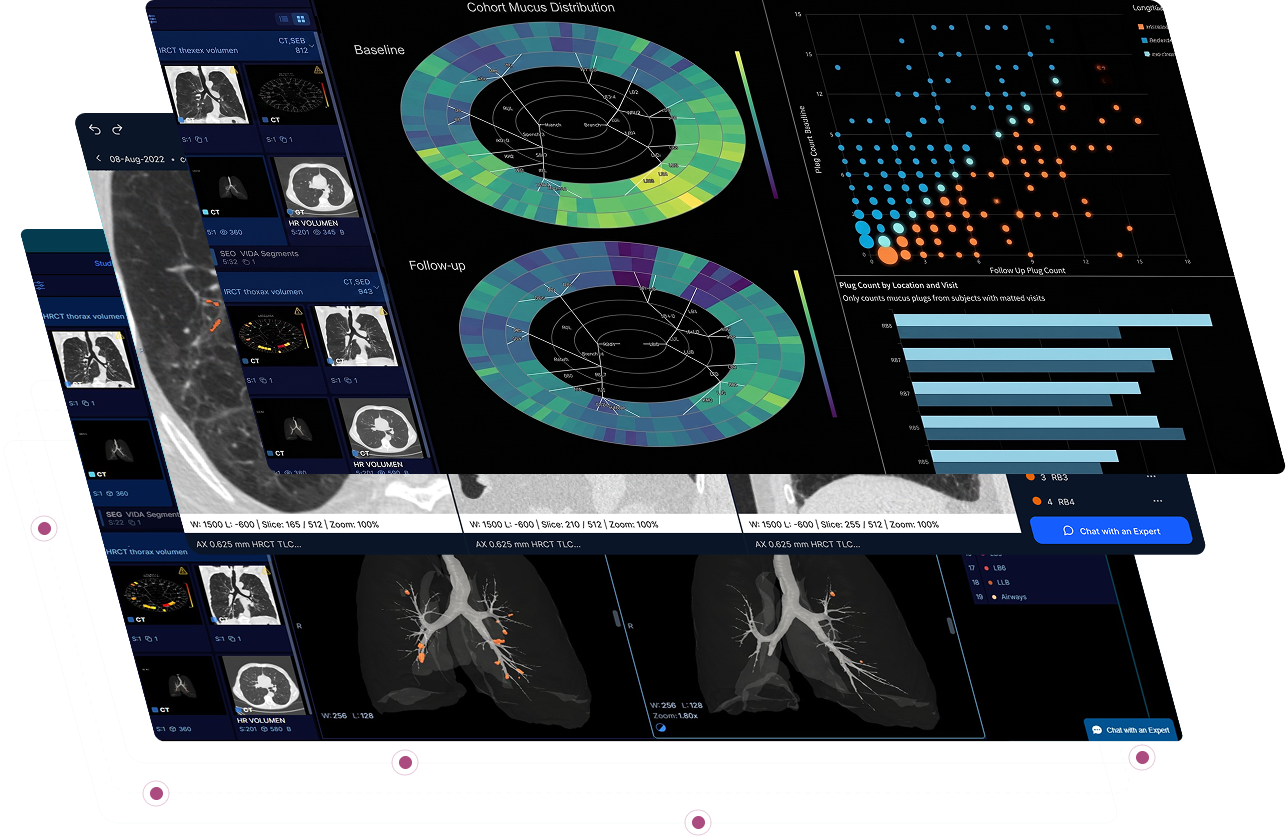

Continuously tap into the value of imaging assets that has been collected either through a formalized trial or RWD sources. Generate new biomarkers, visualize new patterns, explore correlations, all to increase understanding patient response.
Continuously leverage imaging assets for new insights, modeling response, plan future trials and commercialization.

Take existing trial, research, and RWD to form/mine new imaging cohorts.

Add new biomarkers, find patterns, and build/validate understanding of response.

Use established biomarker patterns and site performance to plan future trials and actions.
A new imaging biomarker (airway mucus density) become available after a trial is complete. The sponsor performs a sub-analysis of the strongest responders to see if mucus density was a common factor.
A sponsor is planning a new study and selecting sites. They dive into the operational data within the Digital Biobank to find the best performing sites over the past two trials.